

21st June 2024 – Stonehenge
Visiting Stonehenge during the Summer Solstice has been voted as one of the top 25 life experiences in the world today. To see the sunrise at Stonehenge on the summer solstice is one of those magical moments that will stay with you forever.

Stonehenge was built to align with the sun on the solstices. On the summer solstice, the sun rises behind the Heel Stone in the north-east part of the horizon and its first rays shine into the heart of Stonehenge. On the winter solstice, the sun sets to the south-west of the stone circle.
The summer solstice
The word ‘solstice’ comes from the Latin words for sun (sol) and to stand (sistere). It’s the time of year when the position of the rising or setting sun stands still in its movement along the horizon.
Summer solstice occurs on the longest day of the year, usually 21 June, although the sun’s position remains in pretty much the same place for a few days either side. For Neolithic people, sunlight would have been crucial – for warmth for them and their animals and for helping their crops to grow.
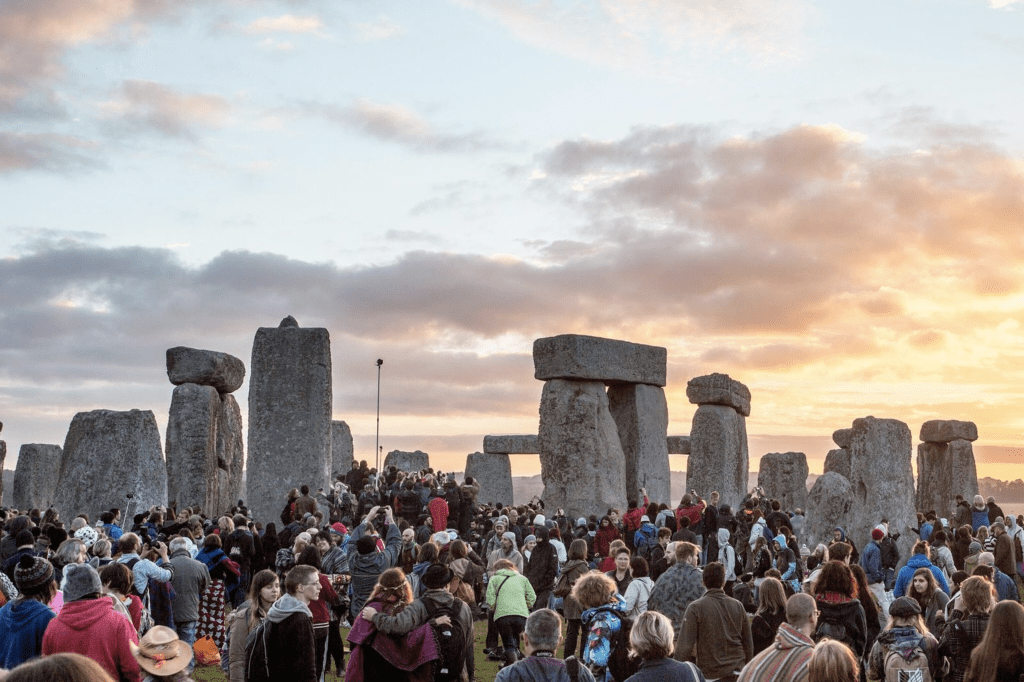
During the summer solstice, the earth’s axis is tilted at its closest point from the sun. This means that in the northern hemisphere, the sun is at its highest point in the sky. It’s also the longest day of the year – and the shortest night.
It would have been relatively easy for prehistoric people to observe the rising and setting positions of the sun each day, and to mark these orientations from any given spot.

UNDERSTANDING STONEHENGE
Spirituality was at the heart of Stonehenge from the start. Neolithic and Bronze Age people put an enormous effort into building this extraordinary structure, despite the fact that it serves no known practical function.
Many theories have been put forward over the years about the purpose of Stonehenge. But what does the evidence suggest that it may have been used for?
ALIGNING WITH THE SUN
The sarsen stones, put up in at the centre of the site in about 2500 BC, were carefully placed to line up with the movements of the sun. If you were to stand in the middle of the stone circle on Midsummer’s Day, you would see the sun rise just to the left of the Heel Stone, an outlying stone north-east of the circle. Archaeologists have found a large stone hole to the left of the Heel Stone which may have held a partner stone: if so, the two stones would have framed the sunrise.
On Midwinter’s Day, the sun would originally have set between the two uprights of the tallest trilithon (two upright stones capped by a horizontal lintel). It would have dropped down over the Altar Stone, a sandstone block which was placed across the solstice axis. Today, this effect has been lost because half of the trilithon has fallen. But a laser survey of Stonehenge has shown that the stones that framed the solstice axis were the most carefully shaped, with vertical sides that framed the movement of the sun.

The whole layout of Stonehenge is therefore designed in relation to the solstices, which are the extreme limits of the sun’s movement. The solstice axis is also marked by the Station Stones, which are placed at the corners of a rectangle around the edge of the surrounding circular ditch. The short sides of the rectangle are parallel to the main alignment at Stonehenge.

The late Neolithic monument known as the Avenue, made up of parallel banks and ditches, links Stonehenge to the nearby river Avon. And it is also linked to the movements of the sun – its final, straight stretch close to Stonehenge is aligned on the north-east to south-west solar axis.
Recent excavations across the Avenue have found that the earthworks appear to follow the line of some ridges, with gullies between them (known as periglacial stripes). These are natural features created by glaciation. But it’s possible that Neolithic people noticed that the ridges and gullies lined up with the solstice, and may have chosen to build Stonehenge here as a result.




 Entertainment Swindon
Leave a comment