
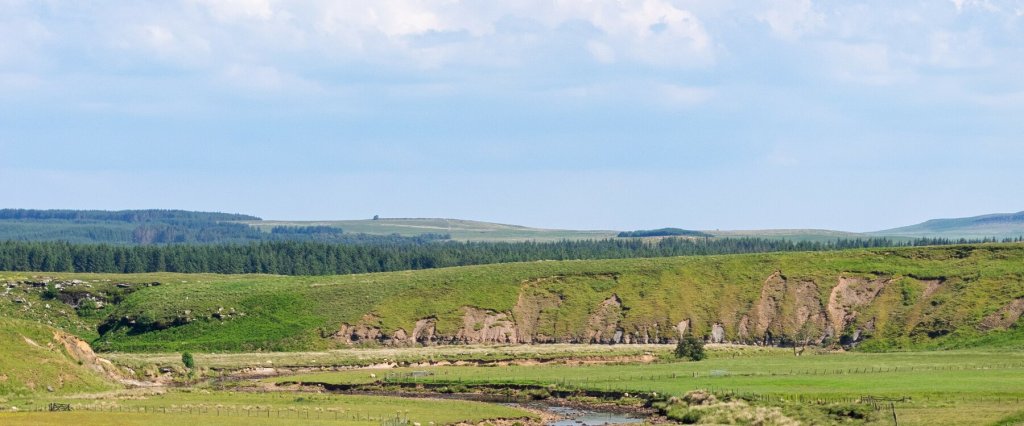
A group of landowners and managers has been awarded funding through DEFRA’s Landscape Recovery scheme to develop the Upper Irthing PRISM Landscape Recovery Project, a transformative approach to sustainable land management.
Covering approximately 9,500 hectares across the Cumbria/Northumberland border up to Scotland, the project will establish a new model for integrated land management focusing on Peatlands, Rivers, Invasives, Species Recovery, and Meadows (PRISM).
Led by Forestry England, the project brings together partners, including Eden Rivers Trust, Natural England, the Ministry of Defence, Northumberland Wildlife Trust, and four private landowners. The initiative will build on successful nature recovery programmes and pioneer new techniques for landscape-scale collaboration that can break down barriers between fragmented land ownership while maintaining productive land use.
Richard Guy, Forestry England Upper Irthing PRISM Landscape Recovery Project manager says:
“This is a very exciting opportunity to think differently: longer term, larger scale and in partnership with neighbouring landowners, allowing us to overlook the usual boundaries of land ownership.
Being in the pilot phase of the Landscape Recovery scheme we can – and are actively encouraged – to think innovatively in terms of funding sources and delivery methods to achieve lasting environmental benefits while supporting sustainable economic activity such as farming and forestry.
This will give us the opportunity to learn lessons that can be applied elsewhere as land management adapts to changing conditions in the future, both financial and environmental”.
The Landscape Recovery scheme is one of DEFRA’s three Environmental Land Management schemes, offering land managers a unique opportunity to co-design custom agreements that deliver environmental and climate goods across large landscapes. After a competitive selection process, Upper Irthing PRISM was chosen for its pioneering ideas to reverse the decline of nature while supporting sustainable agriculture and land use.
Lucy Porrit of Lampert Farm says:
“Nature is in crisis. PRISM is a unique opportunity to improve biodiversity for future generations while building a more resilient farm business.”
Over the next two years, the project team made up of staff from Forestry England and Eden Rivers Trust, will conduct surveys, gather data, and engage stakeholders to craft a long-term plan that benefits nature, landowners, and local communities. Central to the project’s vision is the management of natural habitats and species, balanced with economic activity that benefits rural communities.
As England’s largest land manager, Forestry England has a history of successful nature recovery and habitat restoration. Eden Rivers Trust has collaborated with farmers and landowners to create and implement innovative, sustainable, water-friendly farming solutions, resulting in a more resilient environment and business. This project builds on this established heritage in a new, targeted, partnership approach. This innovative approach to landscape scale land management will allow partnerships to work across boundaries and overcome barriers associated with fragmented land ownership. It will also support private landowners and managers to facilitate positive environmental improvements on their land, while allowing for food, fuel, and fibre production activities to continue.
John Rattray, Head of Operations at Eden Rivers Trust says:
‘Eden Rivers Trust is delighted to be a partner in the first phase of the PRISM landscape recovery project covering over 9,500ha in North Cumbria.
This landscape project offers us the chance to expand on our very successful Water vole reintroduction programme, and, through engagement with local riparian Landowners and PRISM partners, continue the march forward to eradicate North American mink – the invasive non-native species that has decimated water vole populations since being brought to these shores.’
The Upper Irthing PRISM project also focuses on environmental resilience, tackling issues like wildfire prevention, water management, biodiversity, and climate change. While approximately 3,000 hectares of productive forest will remain operational, the project will explore alternative management practices for watercourses and open habitats, providing a test bed for future approaches to land stewardship.



 Entertainment Swindon
Leave a comment