
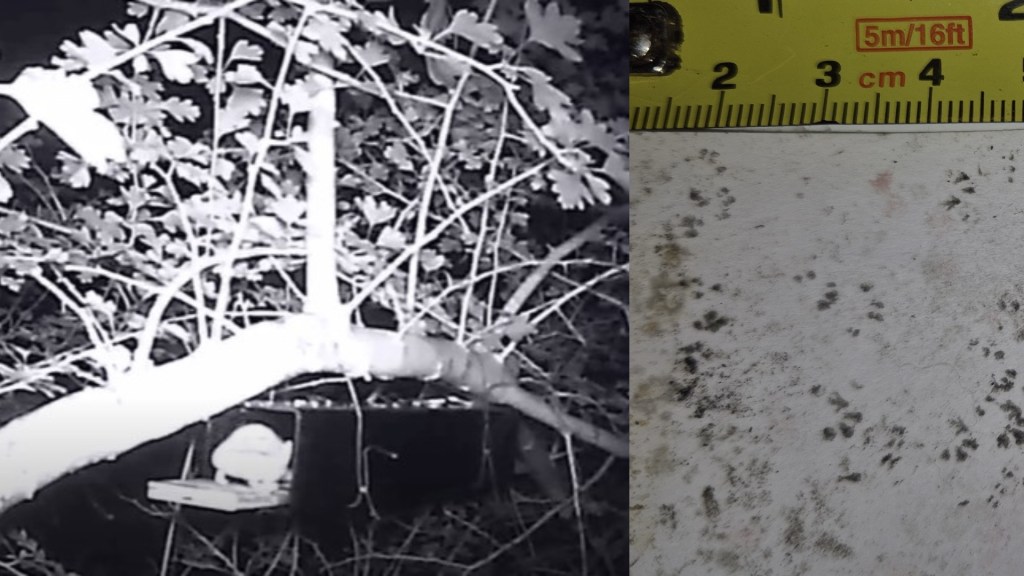
This grainy video shows one of the UK’s rarest mammals, a hazel dormouse foraging for food, and incredibly conservationists have also been able to capture the tiny animal’s footprints in a study at Longleat in Wiltshire.
The creatures are rarely spotted because they spend a lot of their time asleep and only come out at night.
The UKs dormouse population has fallen by at least 52% since 2009, mainly due to the loss of ancient woodland and mature hedgerows.
Dr Tom Lewis, Longleat’s Conservation and Research Manager, said: “At Longleat, the majority of the woodland on the estate is managed as continuous cover forestry. This means that an area is never clear felled.
“Instead, the woodlands can mature and are then thinned on rotation to allow habitat variation and natural regeneration.
By managing the woodland this way, we create a mixture of different age trees, from saplings to ancient trees. This is the type of habitat that is ideal for dormice.
“We were so pleased to capture images of them using camera traps and then to be able to see their footprints. We conducted a footprint tunnel survey to determine whether we have dormice and how much woodland they use.
“This methodology uses biodegradable ink and a white card in a tunnel to identify dormouse from their distinctive footprints. Incredibly, we found dormice in almost half of all sites in the section of the woodland we searched. This demonstrates the rich habitat the woodlands provide.
“Dormice are an important part their ecosystems, being both predator and prey. Depending on the time of year they will feed in insects, flower blossom, nuts and fruits. Their need for a continual supply of food from a variety of sources means they need woodlands with a wide variety of insect and plant life.”
It is the latest discovery for the team at Longleat where beaver territories and pine martens have also been discovered in recent years; last year this included video footage of beaver kits.
Factfile:
- Hazel dormouse or common dormouse (Muscardinus avellanarius),
- One of the UKs rarest mammals.
- Found in hedgerows and woodland
- Will hibernate for as many as seven months over winter
- Diet: In spring they will eat flower and tree blossom as well as insects like caterpillars. In autum they will be feasting on fruits, nuts and seed so they can build up their fat stores for their winter hibernation
- Size: Their body is around 6 to 9 cm, their tail is about the same length. They will weigh up to 40g before they go into hibernation.




 Entertainment Swindon
Leave a comment